YIELD POTENTIAL
Delayed Planting
- Historical planting date research in soybeans has often focused on the negative yield impacts of late planting.
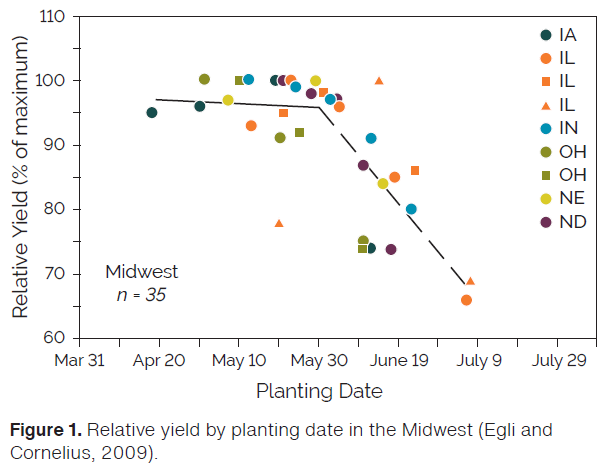
- The potential for significant yield reduction associated with late planting has been well-documented – with a rapid decline in yield potential beginning around May 30th in the Midwest, at a rate of about 0.7% per day (Figure 1, Egli and Cornelius, 2009).
EARLY PLANTING FOR HIGHER YIELD
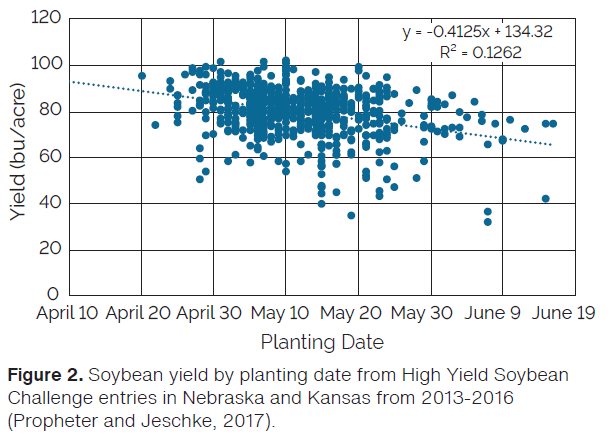
- A series of more recent data suggests the potential to increase soybean yield with earlier planting, in contrast to prior work which often showed little benefit to late-April or early May planting compared to mid- to late-May planting. Survey data from the High Yield Soybean Challenge research effort in Nebraska and Kansas found a 0.41 bu/acre/day linear decrease in soybean yield beginning at the earliest observed planting dates in late April (Figure 2, Propheter & Jeschke, 2017).
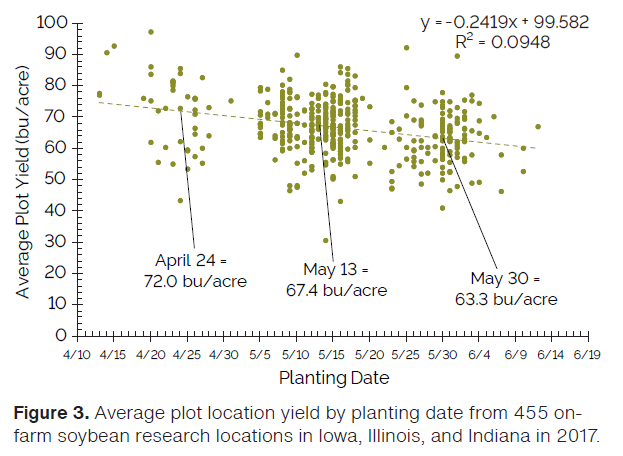
- A similar trend was observed with on-farm soybean plots in Iowa, Illinois, and Indiana in 2017, with a decline of 0.24 bu/acre/day from the earliest planting dates (Figure 3).
- In both of these examples, there are certainly other factors influencing yield at each single location, as indicated by the clusters of data points; however, this yield by planting date trend appears to be real and repeatable.
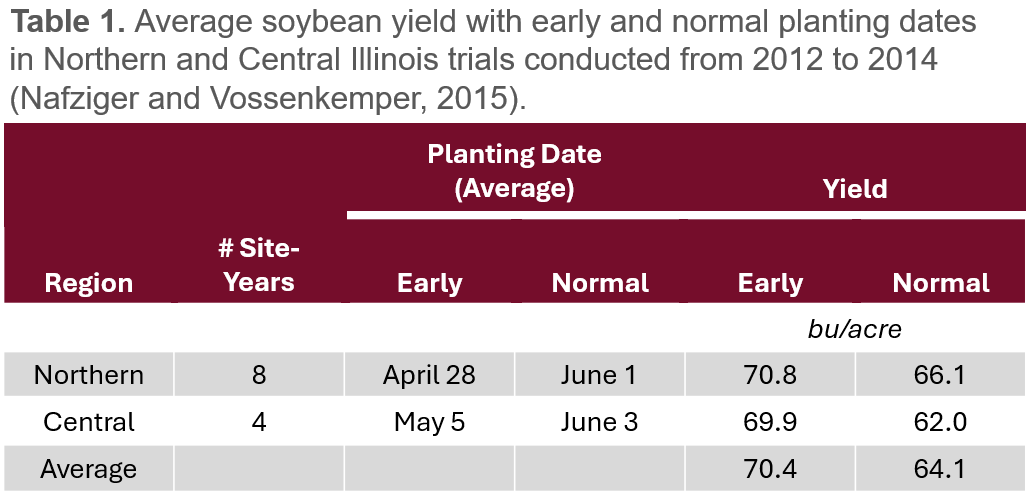
- Similar trends have been observed in recent planting date research. A 3-year University of Illinois study showed significant yield benefit with earlier planting in Northern and Central Illinois (Table 1).
- Recent research exploring the effects of different management factors on soybean yield have often placed planting date near the top of the list.
- A sampling effort conducted across 18 states in 2017 to identify important soil and tissue nutrient levels associated with soybean yields found that planting date had the highest correlation with yield of all the nutrient, management, and weather factors investigated.
- Similarly, a University-led research project across 10 states in the North Central US from 2014 to 2015 also found planting date to have the most consistent impact on soybean yield (Edreira et al., 2017). Yield penalties for later planting ranged from 0 to -0.5 bu/acre/day, with the variation in yield response related to the amount of water deficit stress during the later stages of pod setting (R3-R5). Locations that experienced water stress generally had less of a yield response to earlier planting.
PHYSIOLOGICAL EFFECTS
Daylength Interactions
- Soybean phenological development is well known to be influenced by daylength – shorter daylengths will hasten progression through growth stages, while longer daylengths may prolong development.
- This physiological component is critically important for understanding why a soybean crop is responsive to earlier planting.
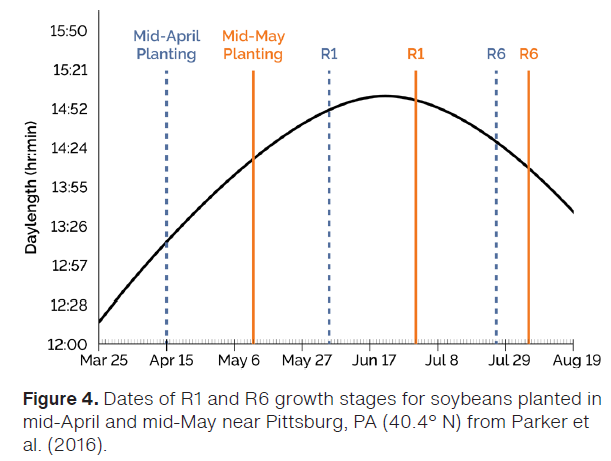
- A study represented in Figure 4 showed that mid-April planting allowed soybeans to begin flowering before the summer solstice, when the days are still getting longer (Parker et al., 2016).
- Not only did early planting allow soybeans to take better advantage of longer daylengths, it also extended the period of reproductive growth – 52 days to reach the R6 growth stage compared to just 37 days for soybean planted in mid-May.
Yield Implications
- The reduction in the length of reproductive development with later planting limits the amount of photosynthate that can be produced and allocated to setting pods and seeds.
- Remember that photosynthate production from R1 to R5 is the primary driver of soybean seed number and yield (Van Roekel & Purcell, 2016).
- Certainly, good management, favorable growing conditions or bright sunny days during pod set can result in high photosynthate production and yields but there is no other way to lengthen the reproductive period than to manipulate planting date and variety relative maturities.
- Of the two, planting date has the larger impact but there may be additional gains that can be achieved by utilizing slightly later maturities (Nafziger and Vossenkemper, 2015).
MANAGEMENT FACTORS
- While the yield data makes a compelling case for early planting, sometimes the weather in April does not.
- For considering when to begin planting soybeans, a minimum soil temperature of 50 ºF (10 ºC) is a good rule of thumb, as it also is for corn planting (Jeschke et al., 2017).
- Like early planted corn, soybeans planted into cold soils may take two to three weeks to emerge.
- However, unlike corn, the growing point for soybeans is above the ground upon emergence. This means that the risk of freezing should be weighed more heavily for soybeans. That said, the large cotyledons are good buffers to protect the growing points from freezing injury and it takes significant cold to be lethal (<28 ºF or -2 ºC for >4 hours).
- Utilizing seed treatments is highly encouraged to protect early planted soybean seeds from prolonged exposure to soil fungi pathogens and early season insects.
- Finally, like many things in agriculture, nothing is guaranteed. Early planting of soybeans will likely have higher yield potential than later plantings but there are many factors that influence your ability to realize and harvest higher yields; such as fertility, weed, insect, and disease control, and the weather.
REFERENCES
Edreira, J.I., S. Mourtzinis, S.P. Conley, A.C. Roth, I.A. Ciampitti., M.A. Licht, H. Kandel, P.M. Kyveryga, L.E. Lindsey, D.S. Mueller, S.L. Naeve, E. Nafziger, J.E. Specht, J. Stanly, M.J. Staton and P. Grassini. 2017. Assessing causes of yield gaps in agricultural areas with diversity in climate and soils. Agricultural and Forest Meteorology. 247:170-180.
Egli, D.B. and P.L. Cornelius. 2009. A regional analysis of the response of soybean yield to planting date. Agron. J. 101:330-335.
Jeschke, M., A. Gaspar and R. Van Roekel. 2017. Effects of cold temperatures following soybean planting. Crop Focus, Pioneer, Johnston, IA.
Nafziger, E. and J. Vossenkemper. 2015. Soybean planting date and varietal maturity interact to determine yield. Agronomy Sciences Research Update, Pioneer, Johnston, IA.
Parker, A., K. Fry and K. Reese. 2016. Planting date effect on soybean reproductive duration. Agronomy Sciences Research Update, Pioneer, Johnston, IA.
Propheter, J. and M. Jeschke. 2017. High yield soybean production in the western corn belt. Crop Insights, Pioneer, Johnston IA.
Van Roekel, R. and L. Purcell. 2016. Understanding and Increasing Soybean Yields. Crop Insights, Pioneer, Johnston IA.
The foregoing is provided for informational use only. Please contact your sales professional for information and suggestions specific to your operation. Product performance is variableand depends on many factors such as moisture and heat stress, soil type, management practices and environmental stress as well as disease and pest pressures. Individual results may vary.